


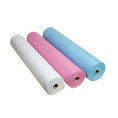


Hydrophilic non woven fabric is a versatile material that has found its way into numerous industries due to its unique properties. As a supplier of hydrophilic non woven fabric, I am often asked about the manufacturing process. In this blog post, I will take you through the detailed steps of how hydrophilic non woven fabric is made.
Raw Material Selection
The first step in making hydrophilic non woven fabric is the careful selection of raw materials. Polypropylene (PP) is one of the most commonly used polymers for non woven fabrics. It is a thermoplastic polymer that offers excellent chemical resistance, high melting point, and good mechanical properties. For hydrophilic non woven fabric, additives are incorporated into the polypropylene to enhance its water - absorption capabilities. These additives can be special surfactants or polymers that have an affinity for water.
The quality of the raw materials is crucial as it directly impacts the final properties of the non woven fabric. We source high - grade polypropylene resins from reliable suppliers and ensure that the hydrophilic additives meet strict quality standards. This ensures that our hydrophilic non woven fabric has consistent performance and meets the diverse needs of our customers.
Extrusion
Once the raw materials are selected, they are fed into an extruder. The extruder is a machine that heats the polymer resin to its melting point. In the case of polypropylene, the melting point is typically around 160 - 170°C. As the polymer melts, it becomes a viscous liquid that can be easily processed.
The hydrophilic additives are also added at this stage. They are thoroughly mixed with the molten polypropylene to ensure a uniform distribution throughout the material. The extruder has a screw mechanism that pushes the molten polymer through a die. The die has small holes, and as the polymer passes through these holes, it forms fine filaments. These filaments are the building blocks of the non woven fabric.
Spinning
After extrusion, the filaments are spun into a web. There are different spinning methods, but the most common one for making non woven fabrics is spunbonding. In spunbonding, the filaments are drawn out and laid down randomly on a moving conveyor belt. The high - speed air flow is used to stretch and orient the filaments, which helps to improve the strength and uniformity of the web.
The spinning process is carefully controlled to ensure that the filaments have the right diameter and orientation. The speed of the conveyor belt, the air flow rate, and the temperature all play important roles in determining the properties of the web. For hydrophilic non woven fabric, we also pay special attention to the distribution of the hydrophilic additives in the filaments during the spinning process. This ensures that the fabric has consistent hydrophilicity across its entire surface.
Bonding
Once the web is formed, it needs to be bonded to give it strength and integrity. There are several bonding methods available, including thermal bonding, chemical bonding, and mechanical bonding.
Thermal bonding is a widely used method for non woven fabrics. In thermal bonding, the web is passed through heated rollers. The heat causes the surface of the filaments to melt slightly, and when they cool down, they bond together at the points of contact. This creates a strong and stable fabric structure.
Chemical bonding involves the use of adhesives to bond the filaments together. The adhesive is applied to the web, and then it is cured to form a bond. Chemical bonding can be used to achieve specific properties, such as enhanced softness or water - resistance.
Mechanical bonding, such as needle punching, involves passing the web through a series of needles. The needles entangle the filaments, creating a strong bond. This method is often used for heavier non woven fabrics.
For our hydrophilic non woven fabric, we choose the bonding method based on the specific requirements of the end - use application. Thermal bonding is often preferred as it can maintain the hydrophilic properties of the fabric while providing good strength.
Hydrophilization Treatment
Although the hydrophilic additives are incorporated during the extrusion process, sometimes an additional hydrophilization treatment is required to ensure optimal water - absorption performance. This treatment can involve spraying a hydrophilic solution onto the surface of the non woven fabric or immersing the fabric in a bath of the solution.
The hydrophilic solution contains special chemicals that further enhance the fabric's ability to absorb and retain water. After the treatment, the fabric is dried to remove any excess moisture. This treatment can be customized based on the desired level of hydrophilicity and the application of the fabric.
Finishing
After the bonding and hydrophilization treatment, the non woven fabric undergoes finishing processes. This can include cutting the fabric into the desired sizes and widths, and applying additional treatments such as antistatic coatings or flame retardants, depending on the customer's requirements.
We also conduct rigorous quality control checks at this stage. We test the fabric for its strength, hydrophilicity, thickness, and other properties. Only the fabrics that meet our strict quality standards are packaged and prepared for shipment.
Applications of Hydrophilic Non Woven Fabric
Hydrophilic non woven fabric has a wide range of applications. In the medical industry, it is used for surgical gowns, masks, and wound dressings. The fabric's ability to absorb fluids makes it ideal for these applications, as it helps to keep the patient dry and reduces the risk of infection.
In the hygiene industry, hydrophilic non woven fabric is used in baby diapers, adult incontinence products, and feminine hygiene products. It provides excellent moisture management, keeping the skin dry and comfortable.
In the agricultural industry, it can be used as Non Woven Fabric For Vegetable Greenhouses. The fabric can help to retain moisture in the soil and protect the plants from harsh environmental conditions.
In the packaging industry, bouquet packaging non - woven fabric is a popular application. The hydrophilic properties can help to keep the flowers fresh by providing a moist environment.


We also offer Black Color Biodegradable Non Woven Fabric for customers who are looking for environmentally friendly options. This fabric is made from biodegradable polymers and still retains its hydrophilic properties.
Conclusion
The manufacturing process of hydrophilic non woven fabric is a complex and precise one. From raw material selection to finishing, each step plays a crucial role in determining the final properties of the fabric. As a supplier, we are committed to using the latest technology and strict quality control measures to ensure that our hydrophilic non woven fabric meets the highest standards.
If you are interested in our hydrophilic non woven fabric or have specific requirements for your application, please feel free to contact us for procurement and negotiation. We are always ready to provide you with high - quality products and excellent customer service.
References
- Brown, R. A. (2005). Nonwovens: An Introduction. Elsevier.
- Csiszár, I. (2012). Handbook of Nonwovens. Elsevier.
- Lewin, M., & Pearce, E. M. (Eds.). (1998). Handbook of Fiber Science and Technology: High - Performance Fibers. Marcel Dekker.