

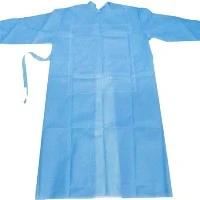
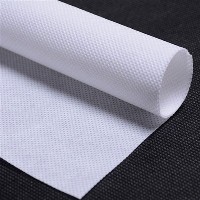


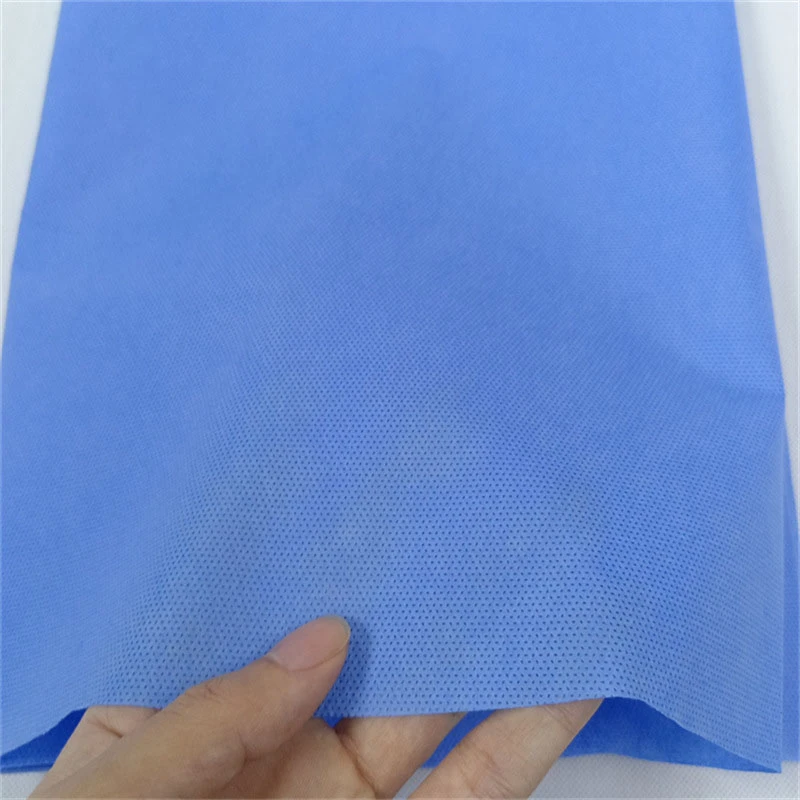
Surgical gowns are designed to provide a protective barrier between healthcare professionals and potential sources of contamination. The choice of fabric can therefore have an important influence on protection, comfort, and manufacturing performance. So, what are the advantages of using nonwoven fabric for surgical gowns?
1. Lightweight and Comfortable
Nonwoven fabrics such as PP spunbond, SMS, and SMMS can provide lightweight structures suitable for disposable surgical gowns. Their relatively low weight can help reduce the overall burden on the wearer during extended procedures.
2. Barrier Protection
Multilayer nonwoven structures can be engineered to provide different levels of resistance to liquids, moisture, and particles.
For example, SMS and SMMS nonwoven fabrics combine spunbond layers with a meltblown layer, creating a structure that can provide a balance of barrier performance and breathability.
For applications requiring higher liquid resistance, PE laminated nonwoven can also be considered.
3. Breathability
Breathability is an important consideration for surgical gowns because healthcare workers may wear protective garments for extended periods.
The structure and basis weight of nonwoven fabric can be selected according to the required balance between barrier properties, air permeability, softness, and comfort.
4. Good Mechanical Strength
PP spunbond layers can provide useful tensile strength and tear resistance, helping surgical gowns maintain their structural integrity during use and handling.
Different basis weights and nonwoven structures can be selected according to the requirements of the finished gown.
5. Suitable for Disposable Products
Nonwoven fabrics are well suited to disposable medical products because they can be produced efficiently in roll form and processed into finished garments through cutting, sewing, ultrasonic bonding, or other manufacturing methods.
This makes them suitable for large-scale production of disposable surgical gowns and other protective apparel.
Conclusion
Nonwoven fabric offers surgical gown manufacturers a combination of lightweight construction, barrier performance, breathability, mechanical strength, and efficient processing.
The appropriate fabric should be selected according to the intended use, required protection level, and applicable medical-device or protective-apparel standards. For manufacturers, choosing the right combination of GSM, layer structure, and material properties is essential for developing a surgical gown that meets its intended performance requirements.