


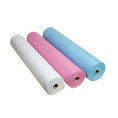


Hey there! As a supplier of Blue PE Laminated Tissue Paper, I often get asked about its properties, and one question that pops up quite a bit is whether it has any anti - static properties. Let's dive right in and explore this topic.
First off, let's understand what Blue PE Laminated Tissue Paper is. It's a type of paper that combines the softness of tissue paper with the durability and moisture - resistance of polyethylene (PE) film. The blue color might be for aesthetic reasons or for specific industry requirements, like in food packaging where color - coded materials are used to distinguish different types of products.
Now, onto the anti - static properties. Static electricity is that annoying shock you get when you touch a metal object after walking on a carpet or when clothes stick together in the dryer. In industrial and packaging applications, static can cause a whole bunch of problems. It can attract dust and dirt, which is a big no - no when you're trying to keep products clean. It can also lead to issues with machinery, causing jams or malfunctions. And in some cases, static can even create a fire or explosion hazard, especially in environments where flammable gases or dust are present.
So, does Blue PE Laminated Tissue Paper have anti - static properties? Well, it depends. Standard Blue PE Laminated Tissue Paper may not inherently have strong anti - static characteristics. The polyethylene film on the paper is an insulator, which means it can build up static charge easily. When two materials rub against each other, like the paper moving through a packaging machine, electrons can be transferred, creating a static charge.
However, there are ways to make Blue PE Laminated Tissue Paper anti - static. One common method is to add anti - static agents during the manufacturing process. These agents work by either reducing the generation of static charge or by allowing the charge to dissipate more quickly. Anti - static agents can be incorporated into the polyethylene film during extrusion or applied as a coating on the surface of the paper.
There are different types of anti - static agents. Some are ionic, which means they work by attracting moisture from the air. The moisture helps to conduct the static charge away from the surface of the paper. Others are non - ionic and work by altering the surface properties of the material to reduce friction and static generation.
If you're in an industry where anti - static properties are crucial, you'll want to look for Blue PE Laminated Tissue Paper that has been specifically treated with anti - static agents. For example, in the electronics industry, where even a small static discharge can damage sensitive components, anti - static packaging materials are a must. Our Blue PE Laminated Tissue Paper can be customized to meet these requirements.
Another important aspect to consider is the testing of anti - static properties. There are various tests available to measure the static - dissipative capabilities of a material. One common test is the surface resistivity test. This test measures how easily an electrical charge can move across the surface of the paper. A lower surface resistivity indicates better anti - static performance.
Now, let's talk about some of the applications of Blue PE Laminated Tissue Paper and how anti - static properties can be beneficial. In the food industry, anti - static Blue PE Laminated Tissue Paper can help keep food products clean by preventing dust and dirt from sticking to the packaging. It can also be used in the pharmaceutical industry to protect sensitive medications from static - related damage.
In the manufacturing of consumer goods, such as cosmetics and personal care products, anti - static paper can enhance the overall quality of the packaging. It gives a more professional look and ensures that the products reach the consumers in perfect condition.


If you're looking for other types of PE laminated paper, we also offer Wood Pulp PE Laminated Paper. This type of paper is made from wood pulp and is known for its strength and durability. It can also be treated with anti - static agents if needed.
And for those who need disposable options, our Disposable PE Laminated Paper Products are a great choice. They are convenient and can be customized with anti - static properties for specific applications.
In conclusion, while standard Blue PE Laminated Tissue Paper may not be anti - static, it can be made so through the use of anti - static agents. If you're in an industry where static is a concern, it's worth investing in anti - static Blue PE Laminated Tissue Paper. It can save you a lot of headaches in the long run by preventing product damage, machinery malfunctions, and maintaining a clean working environment.
If you're interested in learning more about our Blue PE Laminated Tissue Paper or have specific requirements for anti - static properties, don't hesitate to reach out. We're here to help you find the perfect solution for your packaging needs.
References
- "Handbook of Static Electricity" by E. A. Ash.
- "Plastics Additives: An A - Z Reference" by Geoffrey Pritchard.