


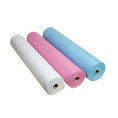


As a supplier of Pet Nonwoven for Floor Leather, one question that frequently comes up in my interactions with clients is whether this product is fire-resistant. It's a crucial inquiry, considering the safety implications in various settings where floor leather is used, such as homes, offices, and public spaces. In this blog, I'll delve into the topic, exploring the fire-resistant properties of Pet Nonwoven for Floor Leather based on scientific knowledge and industry standards.
Understanding Pet Nonwoven for Floor Leather
Pet Nonwoven for Floor Leather is a type of non - woven fabric made from polyethylene terephthalate (PET). Non - woven fabrics are created by bonding or interlocking fibers rather than weaving them, which gives them unique properties. They are widely used in floor leather applications due to their durability, flexibility, and cost - effectiveness.
The manufacturing process of Pet Nonwoven for Floor Leather involves melting PET polymers and then extruding them into fine fibers. These fibers are then laid down in a random pattern and bonded together using heat, chemicals, or mechanical means. The resulting fabric has a consistent structure that can be tailored to meet different requirements, such as thickness, strength, and softness.
Fire - Resistance Basics
Fire resistance is a measure of a material's ability to resist the spread of fire and the generation of heat and smoke. It is typically evaluated based on several factors, including ignition resistance, flame spread rate, heat release rate, and smoke production.
Materials can be classified into different fire - resistance categories according to international standards. For example, in the United States, the National Fire Protection Association (NFPA) has developed a series of standards, such as NFPA 701, which is used to test the flammability of textiles and films. In Europe, the EN 13501 - 1 standard is commonly used to classify the fire performance of construction products.
Fire - Resistance of Pet Nonwoven for Floor Leather
PET itself is a thermoplastic polymer, which means it will melt and flow when exposed to high temperatures. However, the fire - resistance of Pet Nonwoven for Floor Leather can be enhanced through various methods.
Additives
One common approach is to add fire - retardant additives during the manufacturing process. These additives work by either releasing gases that dilute the oxygen around the fire, forming a protective char layer on the surface of the material to prevent further combustion, or interfering with the chemical reactions that occur during the burning process.
There are different types of fire - retardant additives available, including halogen - based, phosphorus - based, and nitrogen - based additives. Halogen - based additives, such as brominated and chlorinated compounds, have been widely used in the past due to their high effectiveness. However, they have raised environmental and health concerns, and their use is being phased out in many countries. Phosphorus - based and nitrogen - based additives are considered more environmentally friendly alternatives and are increasingly being used in the production of fire - resistant materials.
Treatment Processes
In addition to additives, surface treatment processes can also be used to improve the fire - resistance of Pet Nonwoven for Floor Leather. For example, the fabric can be coated with a fire - retardant finish that forms a protective barrier on the surface. This finish can be applied using techniques such as spraying, dipping, or padding.
Another treatment method is to incorporate fire - resistant fibers into the non - woven fabric. For instance, aramid fibers, which are known for their high heat resistance and flame - retardant properties, can be blended with PET fibers to enhance the overall fire - resistance of the material.
Testing and Certification
To ensure the fire - resistance of Pet Nonwoven for Floor Leather, it is essential to conduct rigorous testing. There are several standard tests available, such as the vertical flame test, the horizontal flame test, and the cone calorimeter test.
The vertical flame test involves suspending a sample of the material vertically and exposing it to a flame for a specified period. The length of the charred area and the after - flame time are measured to evaluate the material's flammability. The horizontal flame test is similar, but the sample is placed horizontally during the test.
The cone calorimeter test is a more advanced test that measures the heat release rate, mass loss rate, and smoke production of the material when exposed to a controlled heat source. This test provides more comprehensive information about the fire behavior of the material and is often used for regulatory compliance and product development.
Once the material has passed the relevant fire - resistance tests, it can be certified according to the appropriate standards. Certification provides assurance to customers that the product meets the required fire - safety levels.


Applications and Considerations
Pet Nonwoven for Floor Leather with enhanced fire - resistance has a wide range of applications. It can be used in residential buildings, such as living rooms, bedrooms, and kitchens, to provide a safe and comfortable flooring solution. In commercial buildings, such as offices, hotels, and hospitals, fire - resistant floor leather is essential to meet fire - safety regulations and protect the lives and property of occupants.
However, it's important to note that the fire - resistance of Pet Nonwoven for Floor Leather can be affected by various factors, such as the thickness of the material, the presence of other flammable materials in the vicinity, and the ventilation conditions. Therefore, it's crucial to follow the installation and maintenance instructions provided by the manufacturer to ensure the optimal performance of the product.
Other Applications of Pet Nonwoven
Apart from floor leather, Pet Nonwoven has many other applications. For example, Pet Nonwoven for Farming Bagging is used in the agricultural industry to make bags for storing and transporting crops. It provides a strong and durable packaging solution that can protect the contents from moisture, pests, and mechanical damage.
Pet Nonwoven for Construction Decoration is used in the construction industry for applications such as wall coverings, ceiling tiles, and insulation. It can enhance the aesthetic appeal of buildings while also providing thermal and acoustic insulation.
Pet Nonwoven for Filtration is used in various filtration systems, such as air filters, water filters, and oil filters. Its high porosity and fine fiber structure allow it to effectively trap particles and contaminants, providing clean and safe air, water, and oil.
Conclusion
In conclusion, Pet Nonwoven for Floor Leather can be made fire - resistant through the use of additives, treatment processes, and proper manufacturing techniques. However, it's important to ensure that the product meets the relevant fire - safety standards through rigorous testing and certification.
If you are in the market for Pet Nonwoven for Floor Leather or other Pet Nonwoven products, I encourage you to reach out to me for more information. I can provide you with detailed product specifications, samples, and guidance on choosing the right product for your needs. Whether you are a contractor, a designer, or a homeowner, I am committed to providing you with high - quality products and excellent customer service. Let's start a conversation about your requirements and how we can work together to achieve your goals.
References
- National Fire Protection Association (NFPA). NFPA 701: Standard Methods of Fire Tests for Flame Propagation of Textiles and Films.
- European Committee for Standardization (CEN). EN 13501 - 1: Fire classification of construction products and building elements.
- T. R. Hull. Fire Retardancy of Polymers: New Strategies and Mechanisms. Royal Society of Chemistry, 2001.