


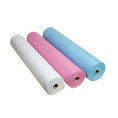


Hey there! As a supplier of SS non woven fabric, I often get asked about the chemical resistance of this amazing material. So, let's dive right in and explore what makes SS non woven fabric stand up to various chemicals.


First off, let's understand what SS non woven fabric is. It's a type of non woven fabric made through a spunbond process. This means that continuous filaments are extruded and laid down randomly to form a web, which is then bonded together. The "SS" usually stands for "spunbond - spunbond", indicating a double - layer spunbonded structure. This structure gives the fabric some unique properties, including its chemical resistance.
Chemical Resistance Basics
Chemical resistance refers to a material's ability to withstand the effects of chemicals without significant degradation. When it comes to SS non woven fabric, its chemical resistance depends on several factors.
One of the key factors is the polymer used to make the fabric. Most SS non woven fabrics are made from polypropylene (PP). Polypropylene has some inherent chemical resistance. It's resistant to many non - polar solvents like hydrocarbons. For example, it can withstand exposure to gasoline, diesel, and other petroleum - based products to a certain extent. This makes SS non woven fabric a great choice for applications where contact with these types of chemicals is possible, such as in the automotive industry for making car interiors or in the packaging of petroleum products.
However, polypropylene is not resistant to all chemicals. It can be attacked by strong oxidizing agents like concentrated sulfuric acid or nitric acid. These acids can break down the polymer chains in the fabric, causing it to lose its strength and integrity. So, if you're planning to use SS non woven fabric in an environment with strong oxidizing agents, you need to be very careful.
Applications Based on Chemical Resistance
Reusable Bags
SS non woven fabric is widely used in making Reusable bag spunbonded cloth. These bags are great because they can handle a variety of substances. For instance, if you use them to carry groceries, they can resist the mild acids and alkalis present in fruits and vegetables. They can also withstand the oils from some food items without getting damaged easily. This is because of the chemical resistance of the polypropylene in the fabric.
Composite Non Woven Fabric
Composite Non Woven Fabric often combines SS non woven fabric with other materials to enhance its properties. In some composite applications, the SS non woven layer provides chemical resistance. For example, in some industrial filtration applications, the composite fabric may be used to filter out chemicals from a liquid stream. The SS non woven part can resist the chemicals in the liquid and maintain its structure, ensuring efficient filtration.
Agricultural Weed Control
Agricultural Weed Control Non Woven Fabric is another area where the chemical resistance of SS non woven fabric is important. In agriculture, various fertilizers and pesticides are used. These chemicals can be corrosive or reactive. SS non woven fabric used for weed control can resist the chemicals in these products, protecting the soil and the plants from unwanted chemical interactions. It can also prevent the chemicals from leaching into the environment, making it an environmentally friendly option.
Testing Chemical Resistance
To determine the chemical resistance of SS non woven fabric, several tests can be conducted. One common test is the immersion test. In this test, a sample of the fabric is immersed in a specific chemical for a certain period of time. Then, the fabric is examined for changes in its physical properties, such as weight loss, strength loss, or changes in color.
Another test is the exposure test. In this test, the fabric is exposed to a chemical vapor or mist for a set duration. This simulates real - world conditions where the fabric may be exposed to chemical fumes. After the exposure, the fabric is evaluated to see if there are any signs of degradation.
Limitations and Considerations
While SS non woven fabric has good chemical resistance in many cases, there are some limitations. The duration of exposure to chemicals matters. Even if a fabric is resistant to a certain chemical, long - term exposure can still cause some damage. Also, the concentration of the chemical is crucial. A low - concentration solution of a chemical may not affect the fabric, but a high - concentration one can be more harmful.
Temperature also plays a role. Higher temperatures can accelerate the chemical reactions between the fabric and the chemicals. So, if the fabric is used in a hot environment with chemicals, its chemical resistance may be reduced.
Conclusion
In conclusion, SS non woven fabric has a decent level of chemical resistance, especially when it comes to non - polar solvents and many common chemicals used in daily life and industry. Its applications in reusable bags, composite materials, and agriculture are a testament to its chemical - resistant properties. However, it's important to understand its limitations and test it thoroughly for specific applications.
If you're interested in purchasing SS non woven fabric for your project, whether it's for making reusable bags, composite materials, or agricultural applications, I'd love to have a chat with you. We can discuss your specific needs and find the best solution for you. Don't hesitate to reach out and start a procurement discussion.
References
- "Nonwoven Materials and Their Applications" by Richard K. Russo
- "Handbook of Nonwovens" edited by S. Ramakrishna